Water entering a Michigan home in February is cold enough to make your fingers ache. Groundwater and municipal lines across the state often run in the low 40s through winter, and every one of those missing degrees has to be added back before a shower feels right. That one fact shapes the tank versus tankless decision here more than any brochure does, because a heater in Flint or Grand Rapids works far harder in January than the same model sitting in a garage in Phoenix.
Most homeowners weighing a switch end up talking it through with a local plumber who has watched both systems age in real basements. Scott Brendel Plumbing is one Michigan company with roughly 25 years behind it, and its customers describe on-demand units installed along with new venting, emergency calls handled, and a one year guarantee standing behind the work. That kind of hands-on history matters, since the right heater for one house can be the wrong pick for the house next door.
The Cold Water Math Nobody Shows You in the Store
Tankless heaters are rated by how many gallons per minute they can warm by a certain number of degrees. Box and showroom figures are usually quoted at a 35 or 45 degree rise. In a Michigan winter you need something closer to 70 degrees of rise to take 45 degree water up to a comfortable 115 degree shower.
That gap shrinks real capacity in a hurry. A unit advertised near 9 gallons per minute might deliver only 4 or 5 in January. With a modern showerhead pulling about 2 gallons per minute, that covers two showers running together, but it starts to strain once the dishwasher or a bathtub joins in.
A tank heater dodges the flow problem by heating water ahead of time. Its limit is volume instead. A 40 or 50 gallon tank gives up most of its hot water before the temperature sags, and once back-to-back showers drain it, a gas model typically needs half an hour or more to catch up. In a busy household on a school morning, that recovery window is where the arguments start.
What Changes Behind the Heater
Replacing a tank with a tankless unit is seldom a straight swap on the same connections. Several parts of the house usually come along for the ride.
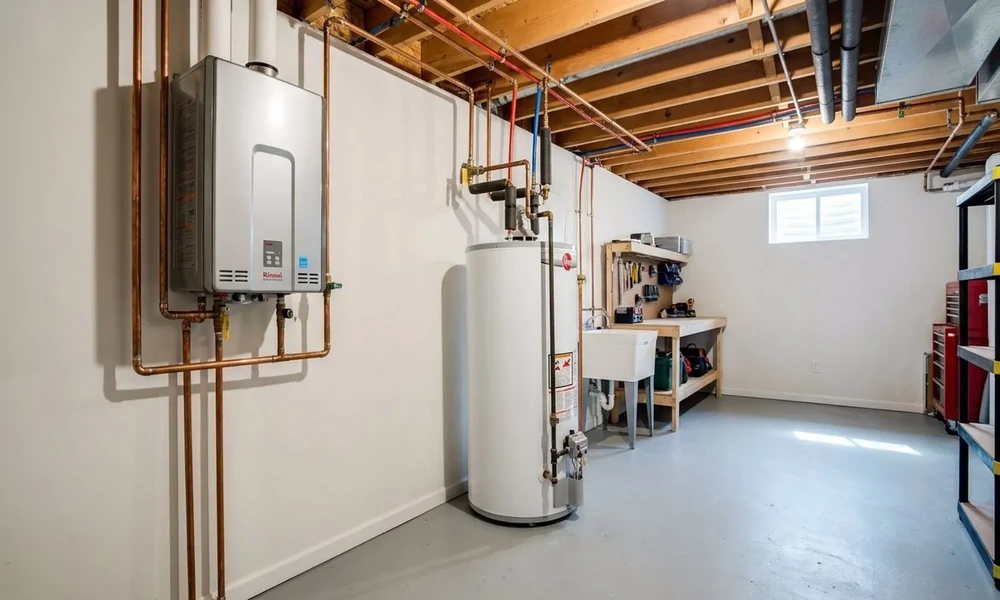
- Gas supply. A standard 40 gallon gas tank burns around 40,000 BTU per hour, while a whole house tankless unit can draw 150,000 to 199,000. The existing half inch line often can’t keep up, so a larger line may need to run back toward the meter.
- Venting. Plenty of older Michigan homes vent the water heater into a masonry chimney shared with the furnace. Tankless units need their own sealed vent, usually PVC for condensing models routed through a sidewall. Pulling the heater off that chimney can leave the furnace alone in a flue sized for two appliances, which deserves a professional look.
- Condensate. Condensing units produce mildly acidic water that needs somewhere to go, ideally through a neutralizer before it reaches the floor drain.
- Power. Gas tankless heaters still need a standard outlet nearby for their fans and controls.
None of these are deal breakers, but they explain why two quotes for “a tankless heater” can land far apart. One house already has the gas capacity and a clear exterior wall. Another needs line work, a new vent path and a chimney liner for the furnace.
Hard Water Takes Its Toll on Both
Southern Michigan draws heavily from limestone aquifers, and well water there can be very hard. Great Lakes municipal water is gentler but still carries enough minerals to leave its mark over time.
Inside a tankless heater, the scale coats the heat exchanger and narrows its passages. Performance drops, error codes appear, and the unit can lock itself out. Flushing it with a descaling solution once a year, or more often on hard well water, keeps it healthy, and isolation valves installed at the start make that a short job.
Tanks suffer differently. Sediment settles on the bottom, insulates the water from the burner, and causes that popping or rumbling sound many homeowners notice after a few years. An annual drain and flush helps, and the anode rod, the sacrificial metal piece that protects the tank lining, should be checked every few years before it wears away completely.
Ice Storms and Dark Houses
Michigan outages tend to arrive in the worst weather, which makes this point worth more attention than it usually gets. A conventional gas tank with a standing pilot and a natural draft vent keeps making hot water with the power out. Power vent tanks and every tankless model shut down until electricity returns.
For homes on a private well, the difference fades, since the well pump stops too. For city water homes in areas with frequent winter outages, though, a working water heater during a two day blackout is a comfort that’s hard to put a price on. A small backup generator or battery can keep a tankless unit running, but that adds planning and cost.
Setting the Two Side by Side
| Factor | Gas tank (40 to 50 gallons) | Condensing gas tankless |
|---|---|---|
| Installed cost | Lower, especially as a like-for-like swap | Noticeably higher, more so with gas and vent upgrades |
| Typical lifespan | About 10 to 15 years | 20 years or more with regular descaling |
| Hot water supply | Limited by stored volume | Continuous, limited by flow rate |
| Winter behavior | Steady output, slower recovery | Flow drops as inlet water gets colder |
| Standby heat loss | Yes, all day and night | None |
| Space | Takes floor space | Mounts on a wall |
| During an outage | Standing pilot models keep working | Stops without electricity |
| Yearly upkeep | Flush sediment, check the anode | Descale the heat exchanger, clean the inlet screen |
Where the Energy Savings Actually Land
According to the U.S. Department of Energy, on-demand heaters can be 24 to 34 percent more efficient than storage tanks in homes using 41 gallons of hot water or less a day, while homes using around 86 gallons see a smaller gain of roughly 8 to 14 percent. ENERGY STAR puts it in dollar terms, estimating that a certified gas tankless unit saves a family of four about $95 a year on gas compared with a standard storage model. The savings come from eliminating standby loss, the heat a tank bleeds into the basement around the clock.
That pattern surprises people. A retired couple in a small ranch saves a larger share of their water heating bill than a family of five, yet the family uses more hot water overall, so their dollar savings can still be meaningful. Payback depends heavily on how much the installation costs up front, which circles back to the gas line and venting questions above.
Heat pump water heaters are a third path some Michigan owners consider. They use far less energy than either gas option, but they pull heat from the surrounding air, so they cool and dry the basement as they run. In an unfinished basement that might be welcome in summer and less so in January.
Fitting the Heater to the House You Have
A couple in a 1990s ranch with a gas meter close to the utility room and an exterior wall nearby is close to an ideal tankless candidate. Their usage is modest, the installation is straightforward, and the long lifespan means they may never replace the unit again.
A large family in a 1950s colonial venting into a shared chimney faces a different calculation. The tankless upgrade could involve new gas piping, a new vent path and a liner for the furnace, and their simultaneous demand on cold mornings may push a single unit to its limit. A well-sized tank, or a high-output tank paired with good pipe insulation, might serve them better for less money.
And a cabin up north on a well, used on weekends, may be best served by whatever is simplest to winterize and drain. The heater that wins in Michigan is rarely the one with the best brochure. It’s the one that fits the water temperature, the gas supply, the venting and the way a particular household actually starts its day.