
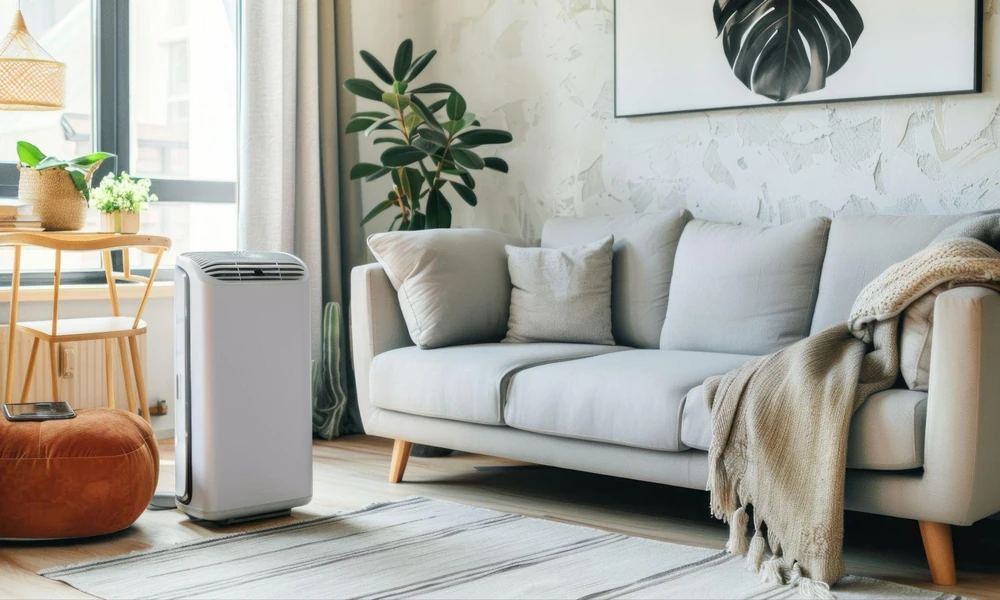
Indoor air can contain particulate matter, pollen, dust, pet-related allergens and odorous compounds. An air purifier is designed to reduce certain airborne pollutants by drawing room air through filtration systems before releasing treated air back into the space.
Different pollutants require different filtration methods. Mechanical filters are primarily used for particles, while activated carbon and other adsorbent materials can be used to address certain gases and odours. Understanding these differences helps explain what an air purifier can and cannot do.
How Do Air Purifiers Capture Fine Particles?
Fine particles are small airborne pollutants that can remain suspended in indoor air. PM2.5, for example, refers to particulate matter with a diameter of 2.5 micrometres or smaller. Their small size makes effective filtration and adequate airflow important considerations.
Many air purifiers use mechanical filtration to capture particles as air passes through the filter. HEPA filters are designed to remove a high proportion of airborne particles under specified testing conditions, although actual performance depends on the complete purifier system and operating conditions.
Particle removal can involve several mechanisms, including:
- Interception: particles following airflow come into contact with filter fibres.
- Impaction: larger or heavier particles deviate from the airflow and collide with fibres.
- Diffusion: very small particles move irregularly and may come into contact with filter fibres.
- Airflow: the volume of air processed affects how quickly airborne particles can be reduced within a room.
Room size and purifier airflow therefore matter alongside the filter itself. Specifications such as clean air delivery rate (CADR), where provided, can help users compare particle-cleaning performance under defined testing conditions.
In short, fine-particle removal depends on both filtration and the amount of air passing through the filtration system.
How Do Air Purifiers Handle Common Allergens?
Some common household allergens can become airborne and therefore be captured by particle filtration. Examples include pollen, dust particles and particles associated with pets.
An air purifier does not, however, eliminate allergens that have already settled on surfaces. Regular cleaning remains necessary because dust, pet-related material and other particles can accumulate on flooring, furniture, bedding and other household surfaces.
Air purification can be relevant to airborne allergens such as:
- Pollen: particles entering indoor spaces can be captured when they pass through an appropriate filter.
- Dust: airborne dust can be trapped by particle filters, while settled dust requires physical cleaning.
- Pet-related allergens: airborne particles associated with pets may be captured, but allergens can also remain on surfaces and fabrics.
- Mould spores: particle filtration can capture airborne spores, but it does not address mould growth or the moisture conditions supporting it.
For example, systems from Dyson can combine particle filtration with other filtration technologies, depending on the model. The specific capabilities and filter configuration should always be checked against the manufacturer’s published specifications.
Overall, air purification can reduce certain airborne allergens, but it works best as part of broader household cleaning and moisture-management practices.
How Do Air Purifiers Reduce Household Odours?
Odours differ from particles because many smells are caused by gases or volatile compounds rather than solid airborne particles. As a result, a particle filter alone is not designed to address every type of household odour.
Activated carbon is commonly used in air purification systems to adsorb certain gases and odorous compounds. Its effectiveness depends on factors such as the properties and quantity of the carbon, the pollutant involved and how air moves through the filtration system.
Common household situations involving odours include:
- Cooking: filtration may help reduce certain airborne odorous compounds, while kitchen ventilation remains important.
- Pets: carbon filtration may address some gaseous compounds associated with odours, but cleaning the source remains necessary.
- Household activities: different products and materials can release gases that may require gas-phase filtration rather than particle filtration.
An air purifier should therefore not be considered a substitute for ventilation or source control. Removing the source of an odour is generally different from filtering pollutants that have already entered the air.
How Do Different Air Purifier Filters Work Together?
Air purifiers may use several filtration stages because particles and gases require different approaches. A pre-filter, particle filter and activated carbon filter can each serve a different function within the same system.
A typical multi-stage arrangement may include:
- Pre-filter: captures larger particles before air reaches subsequent filtration stages.
- HEPA or other particle filter: targets airborne particulate matter, including fine particles and certain allergens.
- Activated carbon filter: adsorbs certain gases and odorous compounds.
- Additional filtration technologies: some models use other systems, whose functions and effectiveness depend on the specific design.
Filter maintenance is also important because accumulated particles can affect airflow, while adsorption media such as activated carbon has a finite capacity for certain pollutants. Replacement and cleaning schedules should follow the manufacturer’s instructions for the particular model.
Ultimately, choosing an air purifier involves matching its filtration system to the pollutants of concern. Particle filtration is suited to airborne particles and allergens, while carbon-based filtration can address certain gases and odours.
Visit Harvey Norman Singapore and manage airborne particles and household pollutants today.